The lawsuit is already sitting in your lead list.
Serial TCPA plaintiffs plant their numbers in the leads you buy. One dial — even to a lead you paid for — can trigger a per‑call statutory claim, a class action, or a federal demand. PropHog Litigation Defender scans every number before you call it: known litigants, the federal Do Not Call registry, and line type.
TCPA litigation isn't slowing down. It's setting records.
Recent TCPA litigation reporting shows the filing curve bending the wrong way for any business that makes outbound calls or sends texts.
Most of these lawsuits aren't from upset consumers. They're from professionals.
TCPA litigation has become a repeat-plaintiff problem. A large share of cases come from people who have filed before and know exactly how to turn a call, a text, an opt-out mistake, or a consent gap into a claim.
In 2025, 397 serial plaintiffs drove the bulk of TCPA filings, and 247 defendants — 11.1% of all defendants — were sued more than once. In financial services specifically, repeat-defendant companies jumped from 64 in 2024 to 116 in 2025: an 81% increase. The same businesses get hit again and again when their screening fails to catch known risks.
Why basic DNC scrubbing isn't enough
- Serial plaintiffs use multiple phone numbers — prepaid phones, burner lines, and recycled numbers.
- You can scrub against the national DNC list and still miss someone with a history of TCPA claims and demand letters.
- The danger doesn't announce itself. The first sign of a bad number is often the demand letter.
The fix is simple: screen the number before the first call goes out.
Scan any number in seconds. Catch the threat before you dial.
Three steps, one pass — this is the actual Litigation Defender at work.

Enter a number
Type any number — or pick a sample. The Defender checks known TCPA litigants, the federal Do Not Call registry, and line type in a single pass.

Run the scan
In seconds, the Defender validates the line, cross-references the litigator database, checks the DNC registry, and compiles a recommendation — then flags the threat.

Get the verdict
A clear, plain-language call: safe, caution, or — like this known serial litigant — do not call. Pull it before it ever reaches a dialer.
What the Defender checks before you dial
Known TCPA litigants
Cross-references a database of people who intentionally file TCPA lawsuits — including serial plaintiffs basic scrubbing misses.
Federal DNC registry
Checks the national Do Not Call registry so registered numbers are flagged before they ever reach a dialer or campaign.
Phone line type
Identifies wireless vs. landline service, so you know the line type and risk profile of every number you contact.
Compliance verdict
Compiles a plain-language recommendation — safe to call, caution, or do not call — so anyone on your team knows what to do.
Compliance vs. negligence
When a complaint or a class action lands, the question regulators ask is simple: what did you do to prevent it? Here is the difference between the two answers.
Screens first, documents everything
- Scans every number before outreach — litigant, DNC, and line type.
- Has a written TCPA & DNC policy that every agent reads and signs.
- Vets every lead vendor and scans all incoming data before it's loaded.
- Gives agents free tools to comply on the fly, at the point of contact.
- Runs internal training and certification — and keeps the records.
Dials raw data, hopes for the best
- Loads purchased leads straight into the dialer, unscreened.
- Has no written policy — agents are never told the rules.
- Never vets lead vendors and never scans incoming data.
- Leaves agents to "figure it out" with no tools and no support.
- Runs no training, keeps no records, exercises no oversight.
When thousands of people make calls in your name, you profit from the activity, and there are no policies, no procedures, and no oversight in place, inaction isn't neutral. To a regulator it can read as complicity in the violations. The opposite of complicity is a documented, good-faith program — and that's exactly what we help you build.
The worst case isn't a plaintiff. It's a federal subpoena.
What is a CID?
A Civil Investigative Demand is a federal government subpoena — issued by the FTC or FCC before any lawsuit is filed — that compels your company to produce documents, records, and sworn testimony on demand. It does not require a plaintiff to trigger it. It needs only complaint volume, a class action filing, or a serial litigant filing directly with the agency. Once issued, it is non-negotiable: ignoring it or responding incompletely is itself a sanctionable offense.
Before any settlement or penalty, simply responding to a CID — legal counsel, document production, and sworn testimony — commonly runs $50,000 to $100,000 or more in legal fees, and can climb into the millions if it escalates into a full enforcement action.
Don't just scan numbers. Build a program you can stand behind.
For organizations with downline agents, the Defender is step one. We help you build the documented, good-faith compliance program that turns "we hoped" into "here's exactly what we did" — modeled on the way carriers run AML.
Education
Get agents and owners to actually understand where TCPA and DNC risk comes from — and what compliance looks like in day-to-day outreach.
Agent agreements
New agreements that alert every agent to TCPA and DNC risk, spell out how to comply, and put their commitment to comply in writing.
Lead & data vetting
Procedures to vet every lead company and scan all incoming data before it touches a dialer, CRM, or texting campaign.
Comply on the fly
Give agents free access to the Defender so screening happens at the point of contact — not after a demand letter arrives.
Training & certification
Internal training and certification programs — run the way carriers handle AML certifications — so agency owners have on-record proof they trained their people and made a real effort to comply.
Start protecting your dials today — free.
Every PropHog account includes 250 free Litigation Defender credits, so you can start scanning numbers right away. Need more credits, bulk scanning for whole lead lists, or a custom compliance program built for your organization? That starts with a conversation.
Don't wait for the demand letter to find out a number was dangerous.
Book a call with our team. We'll show you the Defender, get your credits set up, and map out a compliance program that fits how your organization actually works.
Book your strategy call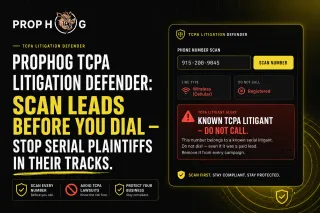
PropHog TCPA Litigation Defender: Scan Leads Before You Dial — Stop Serial Plaintiffs in Their Tracks
Discover PropHog TCPA Litigation Defender: pre-dial scanning for serial plaintiffs, DNC checks, and full compliance tools. Protect your insurance recruiting from costly TCPA lawsuits. ...more
Insurance Recruiting ,Insurance Sales
September 05, 2026•3 min read
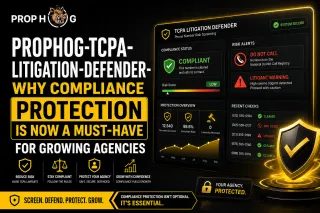
PropHog TCPA Litigation Defender: Why Compliance Protection Is Now a Must-Have for Growing Agencies
PropHog’s TCPA Litigation Defender helps agencies scale high-volume recruiting safely. Smart scrubbing, consent management, and custom compliance tools reduce legal risks while allowing aggressive out... ...more
Insurance Recruiting
August 10, 2026•2 min read
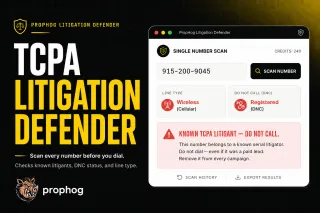
PropHog TCPA Litigation Defender: Protect Your Business While Scaling Aggressive Recruiting
PropHog’s TCPA Litigation Defender helps agencies and recruiters scale high-volume outreach safely. Smart scrubbing, consent tools, and custom compliance programs let you recruit aggressively while pr... ...more
Insurance Recruiting ,Insurance Sales
June 22, 2026•2 min read